
Siding That Matches Without Looking Patched
Siding Installation & Replacement in Saugus for homes where weathered sections, additions, or deteriorated materials have created a mismatched exterior
The Greater Boston region homes age unevenly—original siding weathers and fades over decades while additions installed at different times stand out against the primary structure, creating a patchwork appearance that replacement siding is meant to correct. Matching new siding to existing architecture requires more than choosing a similar color; profile depth, texture pattern, and reveal width all affect whether new sections read as part of the original house or as obvious repairs. Uprising Renovations Inc. in Saugus manages siding replacement projects where the goal is a cohesive finished exterior, not just covered walls.
The inspection process starts by identifying what the existing siding is—material type, profile dimensions, and how it was originally installed—before any removal begins. In Massachusetts, improper flashing at window and door penetrations is one of the most common causes of water intrusion behind siding, so new installation includes flashing at all penetrations, proper fastening schedules for the material being used, and sealed seams at corners and trim. Color and texture are matched either to the existing siding or coordinated across the full house when a complete replacement makes more visual sense than section-by-section matching.
Arrange an exterior assessment to review which sections require replacement and how new material can be matched to your home's existing profile and finish.
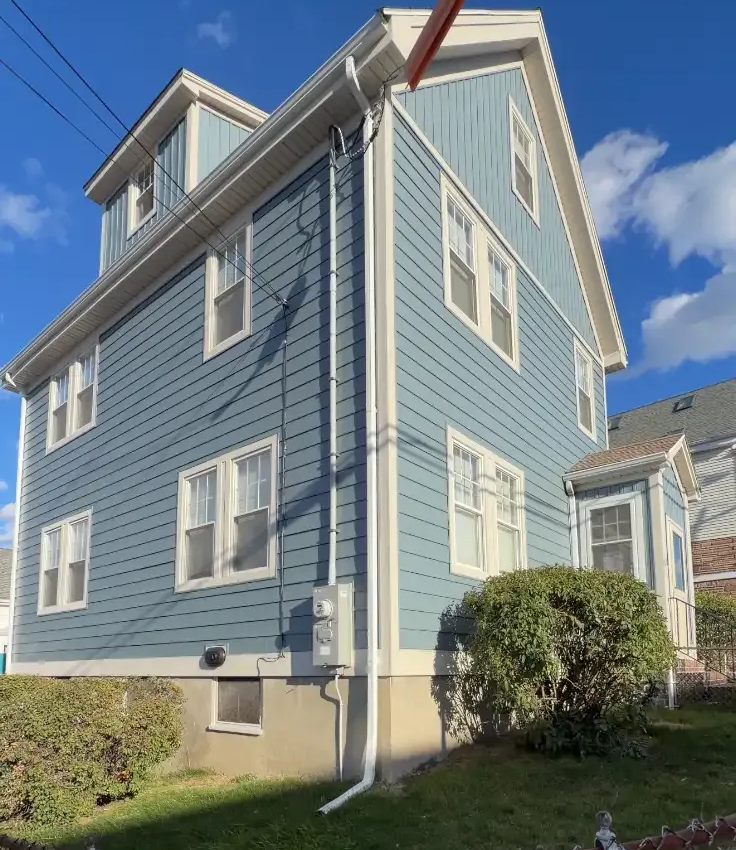
How Siding Replacement Addresses Moisture and Visual Mismatch
Siding in New England takes on moisture stress from multiple directions: wind-driven rain during nor'easters, ice damming that forces water back under lower courses, and the expansion-contraction cycle of cold winters against sun-warmed exterior walls. Deteriorated siding—sections showing cracking, warping, or separation at seams—lets water reach the sheathing underneath, where damage accumulates out of view until it affects interior walls or framing. Removal of damaged sections gives a clear view of sheathing condition, allowing any underlying moisture damage to be identified before new material goes up.
After installation, the exterior reads as a unified surface rather than a record of different renovation phases—trim lines align, corner transitions are clean, and color reads consistently across old and new sections. Uprising Renovations Inc. has handled matching work on additions and repairs extensively enough to understand that no two aging homes present the same profile, which is why the inspection stage determines the approach rather than a standardized package. Properly fastened and flashed siding also eliminates the soft spots and drafts that deteriorated sections allow through exterior walls.
The choice of siding material affects both longevity and installation approach—fiber cement, vinyl, and wood each behave differently in coastal Massachusetts conditions and require different fastening and sealing methods. An unrestricted Massachusetts supervisor's license covers this category of work, and the project scope is defined after inspecting what's currently on the house rather than applying a one-size approach. What's included versus excluded—such as trim replacement, window casing work, or sheathing repair—is clarified before work begins.
What Homeowners Ask Before Replacing Siding
The following questions come up consistently when homeowners in Saugus are evaluating siding replacement projects, particularly on older homes with mixed materials or additions.
How do you match new siding to existing material on an older home?
The profile dimensions—reveal width, thickness, and texture pattern—are measured from existing siding and matched as closely as available materials allow; color is coordinated at the same stage to avoid visible transitions between old and new sections.
What siding material holds up longest in New England coastal conditions?
Fiber cement performs well in high-moisture environments because it doesn't absorb water the way wood does and doesn't expand with heat the way vinyl can in direct sun, though each material has trade-offs that depend on the specific application.
Why does flashing matter more than the siding material itself in Massachusetts?
Flashing at windows, doors, and roof-to-wall intersections is what actually keeps water out—siding is the first line of defense, but improperly flashed penetrations allow water intrusion regardless of how good the siding material is.
When should full replacement be chosen over patching deteriorated sections?
When multiple sections show damage, when the existing profile is no longer manufactured, or when an addition needs to be integrated visually, full replacement typically produces a better result than patching that leaves visible seams.
How does Saugus's climate affect how siding is installed?
The freeze-thaw cycle requires that fasteners allow for slight material movement without loosening, and that all seams are sealed against wind-driven rain that occurs regularly during nor'easter events on the North Shore.
Uprising Renovations Inc. is available to walk through your home's exterior, assess what replacement or matching work involves, and outline the material options that fit your home's existing architecture—contact the office at (339) 203-7056 to set up that review.